Wild Island River
My Father's DragonWild Island River is the broad, muddy waterway that nearly divides Wild Island in two. It first appears to make travel inconvenient, but its banks become the setting for Baby Dragon’s forced ferry work and Elmer Elevator’s rescue attempt. The river is therefore more than a geographic obstacle: the animals’ dependence on crossing it creates the system that confines Baby Dragon, while the same difficult passage makes Elmer’s approach dangerous.
Geography and Island Life
Wild Island River begins near one end of the island and flows into the ocean at the other. Its width and course make a direct route between the island’s two sides impossible without crossing the water. For years, the animals instead walked around the river’s beginning. That detour was burdensome enough to shape ordinary life: visiting was inconvenient, and mail deliveries were slow, especially during the Christmas rush.
The account presents the river through its practical effects rather than as scenery alone. Its muddy breadth determines where the animals can go and how quickly messages and visitors can reach them. The waterway is a persistent feature of island life, and the animals’ impatience with the detour turns that feature into a problem they seek to solve.
Crossing and the Animals’ Solution
The animals could have used Crocodiles to carry passengers and mail across, but they considered Crocodiles moody, unreliable, and liable to look for food. Rather than accept the uncertainty of that arrangement or continue walking around the river, they seized on Baby Dragon as a more controllable means of passage. The river’s practical importance thus helps explain why they treat a young, injured animal as transport.
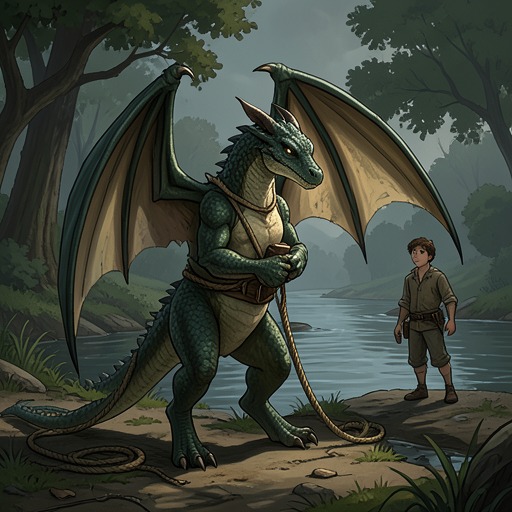
Baby Dragon had fallen from a low-flying cloud onto the riverbank about four months before the cat arrived on Wild Island. He was too young to fly well and had badly bruised a wing, leaving him unable to return to his cloud. The animals found him and recognized a way to end their crossing difficulties. They tied a large rope around his neck and waited for his wing to heal; afterward, they trained him to carry passengers and loads across the water.
The river crossing became a route maintained by force. Baby Dragon was made to work all day, and sometimes all night, under loads that were too heavy for him. When he complained, the animals twisted his wings and beat him. A stake and a rope long enough to reach across the river kept him at the crossing. The arrangement converted a shared geographic inconvenience into compulsory labor imposed on the animal least able to refuse it.
The Riverbank as a Place of Danger
When Elmer arrives at the river after walking through the night, the crossing becomes his immediate problem. He finds a high flagpole with a rope running over to the far side, passing through a loop at the top and down around a crank. Its sign instructs visitors to summon the dragon by yanking the crank and to report disorderly conduct to Gorilla. The equipment makes the river’s crossing system visible: the rope attached to Baby Dragon’s neck links the far bank to an apparatus that lets the animals summon and control him.
Elmer understands that calling Baby Dragon would alert Gorilla. Climbing the pole and moving hand over hand along the rope seems dangerous: the pole is high, the river is muddy, and Elmer fears that unfriendly creatures may live in it. As he considers that route, a Crocodile speaks from the water and invites him to swim, saying it has a craving for something sweet. The river is not merely the distance Elmer must cover; its inhabitants also make entering it perilous.
Rescue at the Crossing
Elmer eventually reaches the opposite bank across a bridge made by Crocodiles, while a wild boar follows onto the first Crocodile’s back. Baby Dragon recognizes that Elmer has come to help and runs from the bushes, calling out that the boar is coming and the others are crossing too. His urgent excitement contrasts with the rope that has held him at the river and the enforced routine of carrying the animals across it.
Elmer runs to Baby Dragon and takes out a very sharp jackknife. He asks him to stand still as he begins sawing through the heavy rope. The danger has now reversed direction: the river crossing that once delivered passengers under the animals’ control is carrying their pursuers toward the rescue. Both boars, all seven tigers, the two lions, the rhinoceros, Gorilla, and screeching monkeys are on their way across while Elmer is still cutting. The scene ends with the river’s two roles held in tension: it is the barrier that made Baby Dragon’s captivity useful to the animals, and the route by which they close in as Elmer tries to free him.